Meta Advances Encryption Infrastructure for Backup Security: Over-the-Air Key Distribution and Deployment Transparency
Strengthening the Foundation of Encrypted Backups
End-to-end encrypted backups are a cornerstone of privacy for messaging platforms like WhatsApp and Messenger. Meta’s HSM-based Backup Key Vault provides the underlying infrastructure that ensures backed-up message history remains accessible only to the user—protected by a recovery code stored in tamper-resistant hardware security modules (HSMs). These HSMs are deployed as a geographically distributed fleet across multiple datacenters, with resilience achieved through majority-consensus replication. This design guarantees that neither Meta, cloud storage providers, nor any third party can access the encrypted backups.
Late last year, Meta simplified the process of enabling end-to-end encrypted backups using passkeys. Now, the company is rolling out two critical enhancements to further protect password-based encrypted backups: over-the-air fleet key distribution for Messenger and a commitment to publishing evidence of secure fleet deployments.
Over-the-Air Fleet Key Distribution for Messenger
To establish a secure session with an HSM fleet, a client must first validate the fleet’s public keys. In WhatsApp, these keys are hardcoded directly into the application. However, for Messenger—where new HSM fleets need to be deployed without requiring users to update their app—Meta built a mechanism to distribute fleet public keys over the air as part of the HSM response.
How the Validation Bundle Works
When a Messenger client connects to an HSM fleet, it receives a validation bundle that contains the fleet’s public keys. This bundle is signed by Cloudflare and counter-signed by Meta, providing independent cryptographic proof of its authenticity. Cloudflare further maintains an audit log of every validation bundle issued, enabling ongoing verification. The complete validation protocol is detailed in the whitepaper, “Security of End-To-End Encrypted Backups.”
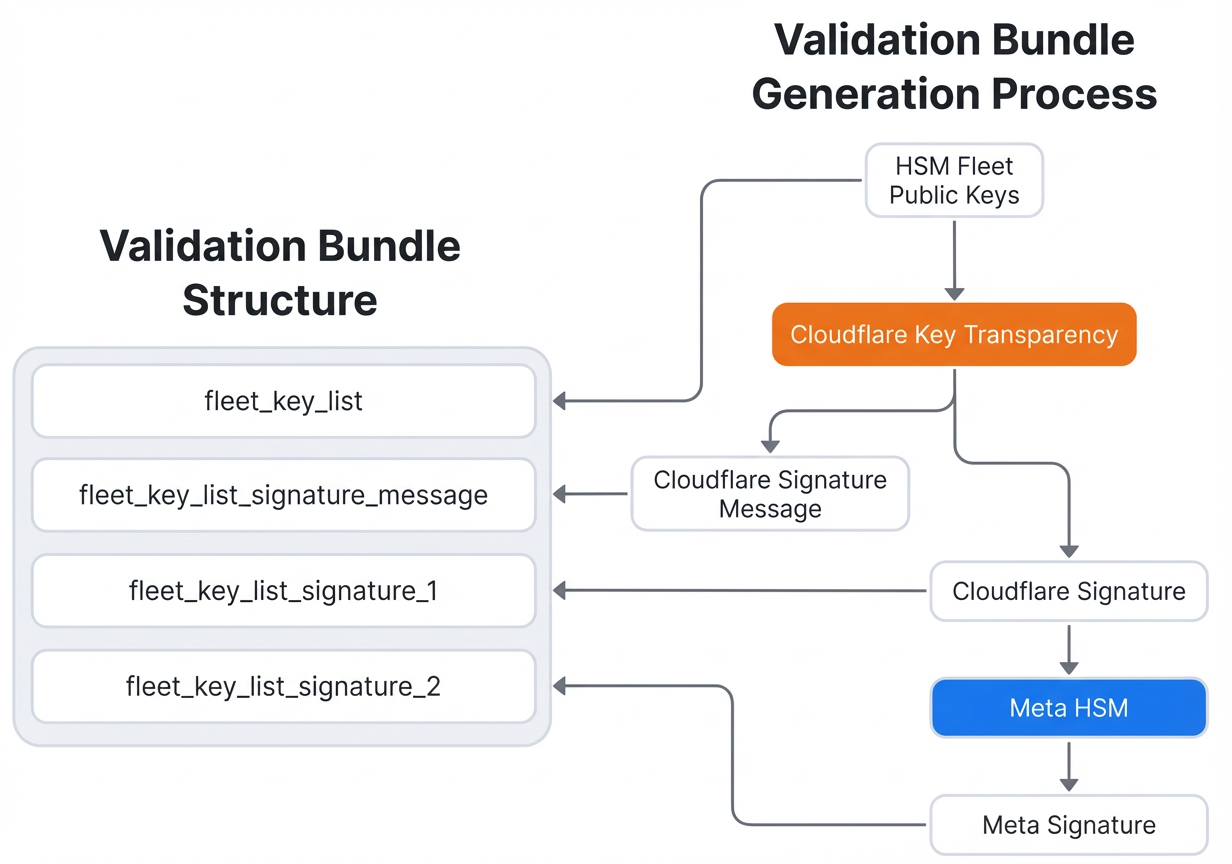
- Independent verification: Two-party signing ensures no single entity can forge a bundle.
- No app update required: New fleets can be deployed seamlessly for Messenger users.
- Auditability: Cloudflare’s audit log provides a transparent record of all key distributions.
More Transparent Fleet Deployment
Transparency is essential to demonstrating that Meta’s HSM fleet operates as designed and that the company cannot access users’ encrypted backups. Starting now, Meta will publish evidence of the secure deployment of each new HSM fleet on this blog page. New fleet deployments are infrequent—typically no more than every few years—but each one represents a critical point of trust.
Verification Steps for Users
Any user can independently verify that a new fleet has been deployed securely by following the steps outlined in the Audit section of the whitepaper. This commitment cements Meta’s leadership in the space of secure encrypted backups.
- Download the published deployment evidence from the blog.
- Follow the cryptographic verification procedures in the whitepaper.
- Confirm that the fleet’s public keys match the attested values.
Read the Full Technical Specification
For a deeper dive into the HSM-based Backup Key Vault, including the complete cryptographic protocols, threat model, and audit guidelines, refer to the official whitepaper: “Security of End-To-End Encrypted Backups.”
Related Articles
- 10 Shocking Facts About Fake Call Log Apps That Stole Millions from Android Users
- German Authorities Identify Russian National as Mastermind Behind REvil and GandCrab Ransomware Gangs
- Critical cPanel Flaw Actively Exploited to Inject Persistent Backdoor – Urgent Patch Required
- GitHub Tightens Bug Bounty Rules to Combat Flood of Low-Quality Submissions
- 5 Creative Uses for Your Old 128GB NVMe SSD (Beyond Storage)
- Weekly Cybersecurity Roundup: Major Breaches, AI-Powered Threats, and Critical Patches (May 4th)
- Defending vSphere Against BRICKSTORM Malware: Key Questions and Answers
- How to Turn an Old Laptop Display into a Portable Monitor