10 Critical Facts About Russia's Sneaky Router Hack to Steal Microsoft Office Tokens
In a quietly devastating cyber espionage campaign, hackers tied to Russia's GRU military intelligence have exploited aging internet routers to intercept authentication tokens from Microsoft Office users—without ever installing malware. This sophisticated attack, uncovered by Lumen's Black Lotus Labs and confirmed by Microsoft, targeted over 18,000 networks at its peak in December 2025, siphoning credentials from government agencies and private organizations alike. Here are ten essential facts you need to understand about this stealthy operation and its implications for global cybersecurity.
1. The Hackers Behind the Operation: Forest Blizzard
The threat actor known as Forest Blizzard—also called APT28 and Fancy Bear—is a well-documented hacking group linked to Russia's Main Intelligence Directorate (GRU). This group gained notoriety for interfering in the 2016 U.S. presidential election by compromising the Democratic National Committee. In this latest campaign, they leveraged their expertise in router vulnerabilities to orchestrate a mass token theft operation targeting Microsoft Office authentication tokens across thousands of networks worldwide.

2. No Malware Needed: A Pure Exploit of Router Flaws
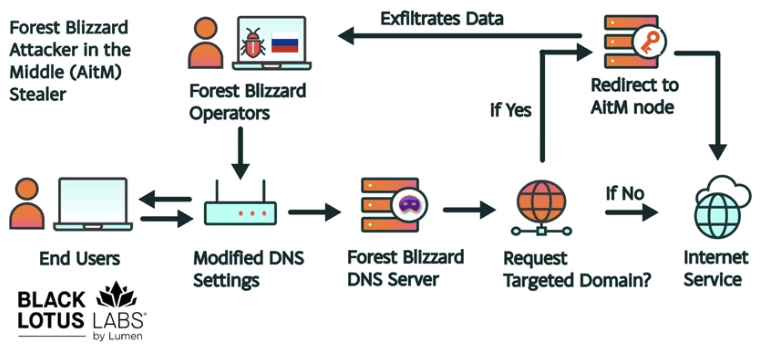
Unlike many cyberattacks that rely on malicious code or backdoors, Forest Blizzard achieved their goal without installing any malware on the compromised devices. Instead, they exploited known security loopholes in older routers—primarily Mikrotik and TP-Link models marketed to small offices and home users. By modifying the routers' DNS settings directly, they redirected traffic without ever triggering antivirus or intrusion detection systems.
3. DNS Hijacking Was the Core Technique
The attack centered on Domain Name System (DNS) hijacking. DNS is the internet's phonebook, translating domain names into IP addresses. By changing the router's DNS configuration to point to attacker-controlled servers, the hackers could intercept every DNS query from connected devices. This allowed them to reroute users to phishing sites or capture authentication tokens sent during login sessions—all while the victim thought they were visiting legitimate websites.
4. Routers Were End-of-Life or Unpatched
At the heart of the vulnerability was the widespread use of unsupported or outdated routers. Researchers found that the vast majority of compromised devices were end-of-life models no longer receiving security updates, or routers running firmware with known, unpatched flaws. This highlights a persistent issue: many organizations and individuals neglect router maintenance, leaving gaping holes for attackers like Forest Blizzard to exploit.
5. Massive Scale: 18,000 Networks Affected
During peak activity in December 2025, the hackers had control over more than 18,000 internet routers. This created a vast surveillance network capable of harvesting OAuth tokens from anyone using Microsoft Office on those networks. The scale of the operation underscores the GRU's ability to conduct mass surveillance without resorting to costly or complex malware deployments, using instead a simple but effective technique.
6. Targets Included Government Agencies and Email Providers
Lumen's Black Lotus Labs reported that Forest Blizzard primarily targeted high-value entities such as ministries of foreign affairs, law enforcement bodies, and third-party email service providers. These organizations often handle sensitive diplomatic and law enforcement communications, making them prime targets for espionage. The theft of OAuth tokens could grant attackers persistent access to email accounts and cloud services, bypassing multi-factor authentication.
7. Microsoft Office OAuth Tokens Were the Prize
The attackers specifically aimed to steal OAuth authentication tokens used by Microsoft Office applications. After a user logs in, a token is generated and transmitted to allow seamless access to Office 365 services. By intercepting these tokens, the attackers could impersonate legitimate users without needing passwords. This technique is particularly dangerous because it evades traditional security measures like password resets and two-factor authentication.
8. A Coordinated Disclosure by Microsoft and Black Lotus Labs
Both Microsoft and Black Lotus Labs published detailed advisories about the campaign. Microsoft identified over 200 organizations and 5,000 consumer devices caught in the dragnet. The UK's National Cyber Security Centre (NCSC) also issued a warning, emphasizing the global threat posed by Russian cyber actors compromising routers. This collaborative disclosure aims to help organizations detect and mitigate similar attacks.
9. The Attack Required Minimal Technical Skill
Despite the sophisticated outcome, the method was surprisingly simple. By scanning for routers with known vulnerabilities, the attackers could execute DNS hijacking using automated scripts. Once a router was compromised, the malicious DNS settings propagated to all users on the local network. This low barrier to entry makes the technique accessible to even mid-level threat actors, raising concerns about copycat attacks.
10. Prevention Requires Router Hygiene and Token Security
Protecting against such attacks demands a two-pronged approach: keep router firmware updated and replace end-of-life devices promptly. Additionally, organizations should implement token binding and short-lived tokens to reduce the window of opportunity for attackers. Regular audits of DNS settings and network traffic can also help detect unauthorized modifications. Awareness and proactive measures are key to staying ahead of GRU-backed hackers.
The Forest Blizzard router hijacking campaign serves as a stark reminder that cyber threats often exploit the most mundane vulnerabilities. By combining outdated hardware with a clever DNS manipulation technique, Russian hackers managed to steal valuable authentication tokens on a massive scale. As the lines between physical and digital security blur, robust router maintenance and vigilant token management are no longer optional—they are essential defenses against state-sponsored espionage.
Related Articles
- The Silent Threat: Why Critical SOC Alerts Are Overlooked and How Radiant Security Bridges the Gap
- How to Respond to a Learning Management System Data Breach: A Step-by-Step Guide for Educational Institutions
- Defend Your Linux Systems: How to Mitigate the Copy Fail Kernel Vulnerability (CVE-2026-31431)
- AI-Powered Cyber Defense Race Heats Up as Frontier Models Transform Threat Landscape
- 6 Critical Shifts in NVD Enrichment Every Container Security Team Must Address
- Oracle Accelerates Patch Cadence to Monthly Cycle Amid AI-Driven Vulnerability Surge
- Mythos Tool Excels at Finding Flaws but Stumbles on Exploit Validation, Benchmark Shows
- Ubuntu Under Siege: DDoS Attack, Twitter Hack, and New Linux Exploit Emerge in Same Week