10 Things You Need to Know About NASA's Artemis II Crew Ringing the Nasdaq Closing Bell
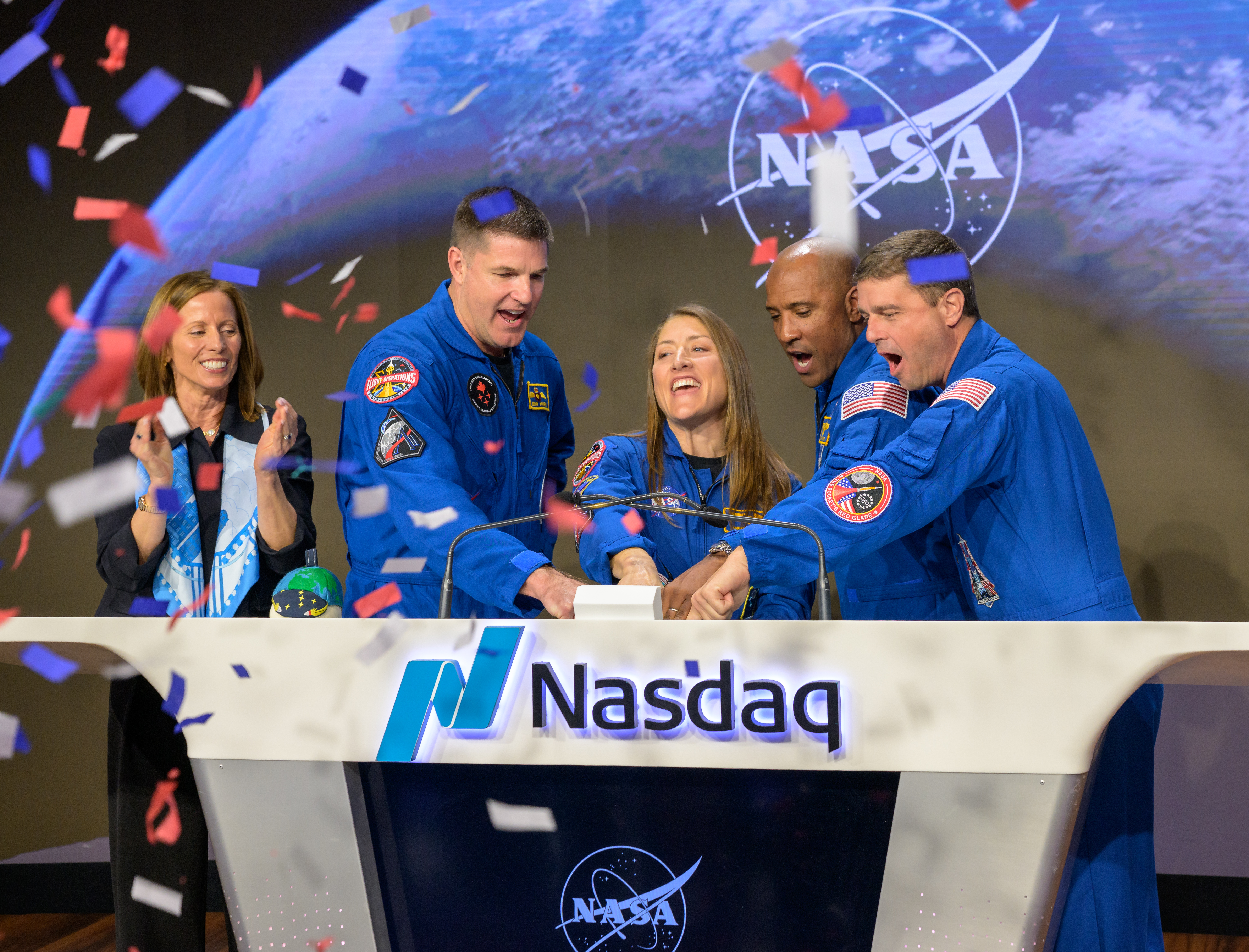
When the four astronauts of NASA's Artemis II mission stepped onto the Nasdaq MarketSite floor on April 30, 2026, they didn't just close the trading day—they marked a defining moment in the new era of lunar exploration. Fresh from their historic around-the-Moon journey earlier that month, the crew's ceremonial bell-ringing celebrated not only their own achievement but also the growing intersection of spaceflight, international partnership, and public engagement. Here are ten key insights into this unique event and the mission behind it.
1. The Mission That Came Before the Bell
Artemis II wasn't just another test flight. It was the first crewed mission in NASA's Artemis program to travel beyond low-Earth orbit since the Apollo era. Launched in April 2026, the mission carried Commander Reid Wiseman, Pilot Victor Glover, Mission Specialist Christina Koch, and Mission Specialist Jeremy Hansen on a nearly ten-day journey that looped around the Moon and returned safely. This pathfinding flight validated life-support systems, navigation, and crew performance ahead of the planned Artemis III lunar landing. The ringing of the Nasdaq closing bell became a powerful symbol of how far humanity has come—and how much further we are poised to go.
2. Meet the Diverse Crew
The Artemis II crew represents a cross-section of talent, experience, and backgrounds. Reid Wiseman, a veteran NASA astronaut, commanded the mission. Victor Glover, a former U.S. Navy test pilot, served as pilot. Christina Koch holds multiple records for longest single spaceflight by a woman. Jeremy Hansen, a Canadian Space Agency astronaut, became the first non-American to fly to the Moon. Their collective expertise in engineering, science, and leadership was crucial for the mission's success. Each crew member brought unique strengths, and their presence at the Nasdaq event highlighted the collaborative spirit that defines modern space exploration.
3. The Nasdaq Event: More Than a Photo Op
The closing bell ceremony at Nasdaq is a time-honored tradition that celebrates milestones in business, innovation, and culture. For NASA, ringing the bell was a strategic opportunity to engage Wall Street and a global audience. Nasdaq CEO Adena T. Friedman welcomed the crew, emphasizing how space exploration drives technological advances that fuel economic growth. The event streamed live on major financial networks, reaching millions. It wasn't just about the astronauts pressing the shiny button—it was a reminder that space is not only a frontier of science but also a driver of new industries, from satellite constellations to lunar resource utilization.
4. Why Wall Street Cares About Lunar Missions
Investors and business leaders see the Moon as the next economic zone. Artemis II's success reinforced confidence in NASA's long-term plans, which include building a lunar outpost (Gateway) and eventually sending humans to Mars. Companies in sectors like robotics, communication, and materials science stand to benefit. The bell-ringing signaled that space is no longer a government-only venture—it's a domain where private capital and public missions converge. The Nasdaq ceremony helped bridge the gap between rocket scientists and financial analysts, showing that exploration and commerce can go hand in hand.
5. International Collaboration at Its Best
Artemis II was a stark contrast to the Apollo-era flags-and-footprints approach. Jeremy Hansen's participation made it the first lunar mission to include an astronaut from another space agency. The Canadian Space Agency contributed critical robotics and science instruments. This partnership is a model for future missions under the Artemis Accords, which now include dozens of nations. The Nasdaq event highlighted this global aspect, as the crew stood together representing the shared ambition of Earth's citizens. When they rang the bell, it was a sound of unity in an often-divided world.
6. A Journey of Nearly 10 Days Around the Moon
The mission's precise trajectory took the crew on a free-return path around the lunar far side. They flew within about 130 kilometers of the Moon's surface at closest approach, capturing breathtaking images and conducting experiments. The journey tested the Orion spacecraft's life support and navigation in deep space. For the crew, it was a chance to witness Earth set behind the lunar horizon—a sight that few have seen. The total flight time was just under ten days, a relatively short but intense sprint that laid the groundwork for longer stays in cislunar space.
7. Preparation: Years of Training in a Minute
Behind the smiling faces at the Nasdaq event were years of grueling preparation. The crew trained in simulators, underwater for spacewalks, and in remote locations to survive emergencies. They learned the intricate systems of Orion, practiced docking maneuvers, and studied lunar geology. Each astronaut spent hundreds of hours in high-fidelity mockups. The bell-ringing was a celebration of that dedication. As Christensen Koch noted in interviews, “The mission may have lasted ten days, but getting ready took a decade of effort.” The Nasdaq audience got to see the polished result of that immense work.
8. The Human Element: Emotional Moments
Before the bell, the crew spoke briefly about their personal highlights. Victor Glover recalled looking out the window and seeing the Moon fill the view—a moment that made time stand still. Jeremy Hansen, the Canadian rookie, described the profound humbleness of seeing Earth as a tiny blue marble. Christina Koch, who had spent almost a year in orbit on a previous mission, said the lunar view was different—more intimate. Their stories resonated with the audience, reminding everyone that behind the hardware are human beings who risk everything to explore. The Nasdaq event gave these personal narratives a global stage.
9. What This Means for the Next Generation
The Artemis II crew deliberately engaged with students and young professionals during their post-mission tour. At the Nasdaq event, they highlighted the STEM Next initiative, encouraging kids to pursue careers in science and technology. For many young viewers, seeing a diverse crew—including a woman, a person of color, and a Canadian—made space feel more accessible. The closing bell ceremony amplified that message. By tying a historic spaceflight to a financial institution, NASA showed that space is not an escape from the world but a way to improve it. The next generation of explorers was watching.
10. The Road Ahead: Artemis III and Beyond
With Artemis II complete, NASA is now focused on landing astronauts on the lunar surface. Artemis III, currently targeted for the late 2020s, will send a crew to the Moon's south pole to search for water ice and test new technologies. The lessons from Wiseman, Glover, Koch, and Hansen will directly inform that mission. The Nasdaq bell-ringing was a punctuation mark on a successful chapter, but the story continues. Private companies like SpaceX and Blue Origin are building landers, and international partners are contributing modules. As the crew stepped away from the bell, they left a resounding message: the Moon is just the beginning.
In a world hungry for inspiration, the Artemis II crew's appearance at Nasdaq served as a bridge between the heavens and the economy. Their journey around the Moon proved that human exploration is alive and thriving. And the closing bell didn't just end a trading session—it opened a new chapter in how we think about our place in the cosmos. Whether you're an investor, a student, or simply a stargazer, the Artemis II mission offers a reminder that the frontier is always calling, and that sometimes, the most profound symbols come from the most unlikely places—like a bell on Wall Street.
Related Articles
- From Air Force Veteran to NASA Launch Operations Chief: A Leadership Guide
- Mastering Arctic Winter Fieldwork: A Step-by-Step Guide to Collecting Lake Sediment Samples
- 10 Key Insights into Long-Term Memory Breakthroughs for Video AI
- Understanding the 'Dead Internet' Theory: A Guide to Analyzing AI's Web Takeover
- Morocco Joins the Artemis Accords: A New Chapter in Global Space Exploration
- How Paleontologists Unearthed a 50-Foot Prehistoric Snake: A Step-by-Step Guide
- The Cosmic Sweet Spot: A Guide to Understanding How Fundamental Constants Enable Life’s Liquids
- How to Get a Free Withings Smart Scale When You Buy a Samsung Galaxy Watch